
Lost-Wax Casting: The Art of Precision Manufacturing
In modern industrial manufacturing, lost-wax casting technology has emerged as one of the preferred processes for producing complex and precision castings due to its exceptional accuracy and flexibility. Whether it is the precision components in the aerospace industry or the exquisite jewelry, lost-wax casting can meet the demands for high precision, complex shapes, and diverse materials with its unique advantages. This article will delve into the process, advantages, disadvantages, and practical applications of lost-wax casting, helping readers gain a comprehensive understanding of this precision manufacturing technology.
Introduction to Lost-Wax Casting
Lost-wax casting, also known as precision casting or investment casting, is a casting process that uses easily melted materials (such as wax and plastics) to create precise, meltable models. These models are then coated with several layers of refractory coatings, which are dried and hardened into a single-piece mold shell. The mold shell is heated to melt away the model, and then it is fired at high temperatures to form a refractory mold shell. Finally, liquid metal is poured into the mold shell, and after cooling, the casting is formed. The process can be summarized as follows: pattern material - injection of wax patterns - assembly of patterns - pattern repair - coating - sanding - demolding - firing - pouring - cooling - shakeout - cleaning. Each step is crucial and collectively ensures the high quality and precision of the casting.
The Process of Lost-Wax Casting
The process of lost-wax casting is complex and meticulous, with each step being indispensable. They are interconnected and together ensure the high precision and quality of the casting.
1. Selection and Preparation of Pattern Material
Pattern material is the foundation of lost-wax casting, and its properties directly affect the quality of the casting. Pattern materials are typically classified by their melting points into high-temperature, medium-temperature, and low-temperature materials. Low-temperature pattern materials have a melting point below 60°C, such as the 50% paraffin wax and 50% stearic acid mixture widely used in China. High-temperature pattern materials have a melting point above 120°C, such as the mixture of 50% rosin, 20% beeswax, and 30% polystyrene. Medium-temperature pattern materials have a melting point between the two, with common types being rosin-based and wax-based materials. The basic requirements for pattern material properties include suitable thermophysical properties (such as melting temperature, thermal expansion, and contraction), good mechanical properties (such as strength and hardness), and excellent process properties (such as viscosity and ash content).
2. Injection of Wax Patterns
Injection of wax patterns is one of the core steps in lost-wax casting. Depending on the state of the pattern material, the injection of wax patterns can be divided into injection molding and extrusion molding. Injection molding is suitable for liquid and semi-liquid pattern materials and is carried out at low pressure, ensuring the smoothness and low roughness of the pattern surface. Extrusion molding is suitable for semi-solid or solid pattern materials and is performed under high pressure, reducing pattern shrinkage and increasing production efficiency, especially for producing castings with thick and large cross-sections. When performing injection molding, the selection of injection temperature and pressure is crucial. Excessive temperature and pressure can lead to an uneven pattern surface and defects.
3. Assembly and Repair of Patterns
Assembly of patterns involves combining multiple patterns to form a complete casting model. Repair of patterns involves fine-tuning the patterns to remove excess material, ensuring the dimensional accuracy and surface quality of the patterns. This step requires high-precision operations to ensure that the final casting meets the design requirements in terms of size and shape.
4. Coating and Sanding
Coating and sanding are two key steps in the shell-making process. Coating involves evenly applying refractory coating on the pattern surface to form a protective layer. Sanding involves evenly spreading sand particles on the coating layer to increase the thickness and strength of the mold shell. The selection of sand particle size needs to be adjusted according to the viscosity and layering of the coating to ensure the quality of the mold shell. During the shell-making process, after each coating and sanding, thorough drying and hardening are required to ensure the strength and stability of the mold shell.
5. Demolding and Firing
Demolding is the process of removing the pattern from the mold shell. This step requires careful operation to avoid damaging the mold shell. Firing involves heating the mold shell to a high temperature to harden it and remove any residual pattern material. The control of firing temperature and time is crucial to the quality of the mold shell. Excessive temperature can cause the mold shell to crack, while insufficient temperature may fail to completely remove the pattern material.
6. Pouring and Cooling
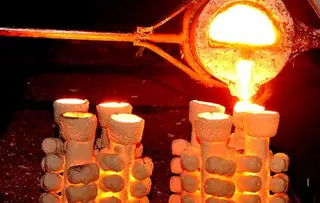
Pouring is the process of pouring liquid metal into the mold shell. The control of pouring temperature and speed has a direct impact on the quality of the casting. Excessive pouring temperature can lead to surface defects in the casting, while too low a temperature may result in insufficient fluidity of the metal, preventing it from completely filling the mold cavity. Cooling is the final step in the formation of the casting, and it requires control of the cooling rate to avoid the formation of cracks or other defects in the casting.
7. Shakeout and Cleaning
Shakeout is the process of removing the casting from the mold shell, and cleaning involves removing residual mold shell and impurities from the casting surface. This step requires meticulous operation to ensure the surface quality of the casting.
Advantages of Lost-Wax Casting
The main advantages of lost-wax casting lie in its high precision and flexibility. Compared with traditional casting methods, lost-wax casting has the following significant advantages.
1. High Precision and Low Roughness
Lost-wax casting can produce castings with high dimensional accuracy and low surface roughness. The general precision can reach grades 5 to 7, with a roughness of Ra25-6.3μm. This means that the casting requires almost no additional machining after forming, significantly reducing production time and cost.
2. Capability of Manufacturing Complex Shapes
Lost-wax casting can produce castings with complex shapes, including thin-walled castings, very light castings, and those with fine patterns, text, and grooves. This capability has made lost-wax casting widely used in the aerospace, automotive, and jewelry industries.
3. Diversity of Material Selection
Lost-wax casting can be used for almost all types of casting alloys, including alloy steel, carbon steel, and heat-resistant alloys. This diversity in material selection allows lost-wax casting to meet the needs of different industries.
4. Flexibility in Production Volume
Lost-wax casting has no limitations on production volume, allowing for both single-piece and mass production. This flexibility enables lost-wax casting to adapt to production needs of different scales, whether for small-batch custom products or large-batch industrial parts.
Disadvantages of Lost-Wax Casting
Despite its many advantages, the complexity of the process and the relatively long production cycle of lost-wax casting are also significant drawbacks. Each step in lost-wax casting requires precise control, and any problem in one step can lead to a decline in casting quality. In addition, lost-wax casting is not suitable for producing castings with large contour dimensions, as the preparation of the mold shell and the pouring process for large castings pose greater technical challenges.
Applications of Lost-Wax Casting
Lost-wax casting is widely used in aerospace, automotive manufacturing, mechanical engineering, jewelry, and other fields. In the aerospace industry, lost-wax casting is used to produce complex parts such as engine blades and turbine discs. In automotive manufacturing, it is used for key components such as engine blocks and transmission housings. In the jewelry industry, lost-wax casting can produce exquisite rings, necklaces, and other ornaments. These application fields have very high requirements for the precision and quality of castings, and the high precision and flexibility of lost-wax casting make it an ideal choice.
Defects of Lost-Wax Castings and Solutions
Although lost-wax casting technology is very mature, some defects can still occur in actual production. These defects can be divided into surface and internal defects, as well as dimensional and roughness deviations. Surface and internal defects include incomplete casting, cold shuts, shrinkage porosity, gas porosity, inclusions, hot tears, and cold tears. Dimensional and roughness deviations mainly include elongation and deformation of the casting. The causes of these defects are varied, such as the pouring temperature of the alloy liquid, the firing temperature and preparation process of the mold shell, and the design of the pouring system and casting structure. The solutions to these defects need to be analyzed based on specific situations. For example, incomplete casting can be solved by increasing the pouring temperature, optimizing the design of the pouring system, and ensuring sufficient firing of the mold shell.
Conclusion
Lost-wax casting, as a high-precision and flexible casting technology, plays an important role in modern industrial manufacturing. Its complex process, diverse material selection, and wide adaptability to production volumes enable it to meet the needs of precision castings in different industries. Although there are disadvantages such as process complexity and long production cycle, these issues are being gradually resolved with continuous technological progress. In the future, lost-wax casting technology will be applied in more fields, bringing higher efficiency and better quality to industrial manufacturing.
In summary, lost-wax casting is not only a technology but also an art. It perfectly combines science and craftsmanship, providing strong support for modern industrial manufacturing.
Send your message to this supplier
Related Articles from the Supplier
Lost-Wax Casting: The Art of Precision Manufacturing
- Aug 19, 2025
Related Articles from China Manufacturers
Related Products Mentioned in the Article

Supplier Website
Source: http://www.forging-casting-stamping.com/lost-wax-casting-the-art-of-precision-manufacturing.html